July 28, 2026 • 12 min read
The Middle Rhine Valley (Oberes Mittelrheintal) between Mainz and Koblenz has 32 castles in 65 kilometers — the greatest concentration of medieval castles anywhere in Europe. UNESCO listed. Home to the Lorelei rock, the wine villages of Bacharach and Rüdesheim, and the river cruise industry that turned this stretch into one of Europe's iconic scenic routes in the 19th century.
This guide covers the essential castles, how to visit them (train, boat, car, or river cruise), the best wine villages to base in, and how to combine the Rhine with Cologne and Frankfurt.
The short answer
Where: The UNESCO Middle Rhine Valley runs from Koblenz (north) to Bingen (south), about 65 km. This is the "castle stretch." Beyond it (north to Cologne, south to Mainz and Frankfurt), the Rhine is wider and less castle-dense.
How to visit:
- Rhine cruise (KD Line, from Koblenz to Rüdesheim or reverse, 4-8 hours) for the classic experience.
- Train along the west bank (regional trains, castles visible from window).
- Rental car on the B9 (west bank) or B42 (east bank) for wine tastings and village stops.
Best time: Mid April to mid October for boat cruises. September for wine harvest. December for Christmas cruise options (limited).
Where to base: Rüdesheim (wine village, southern end), Bacharach (medieval wine village, mid-valley), or Boppard (northern half, spa town).
Combine with: Cologne (1h drive north), Frankfurt (1h drive south), Heidelberg (1h30m southeast), Alsace France (2h southwest).
The essential castles
Not all 32 castles are open to visitors, and not all reward a visit. Here are the 8 castles worth planning around.
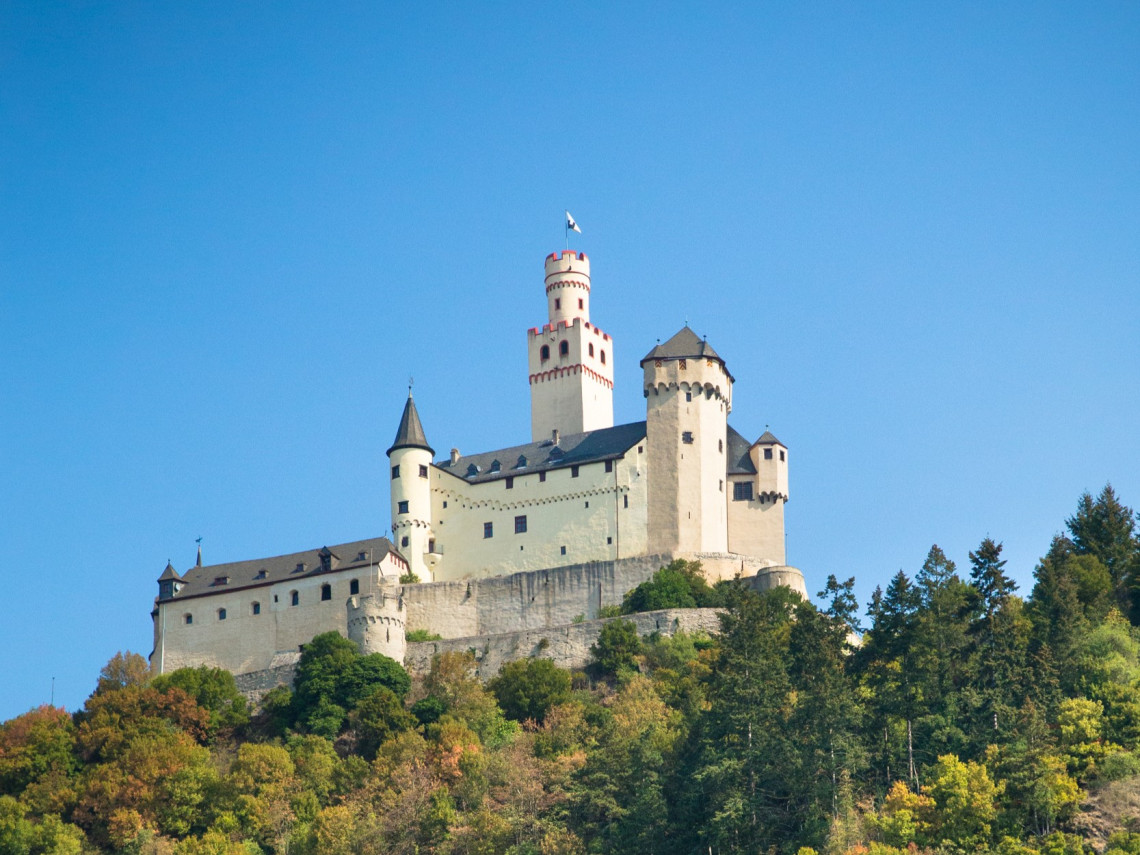
1. Marksburg — the only never-destroyed medieval castle
Where: Above Braubach, east bank of the Rhine, 15 km south of Koblenz.
Why it matters. Marksburg is the only Rhine castle that was never destroyed. Every other Rhine castle you see is either a rebuilt 19th-century Romantic restoration (Rheinstein, Stolzenfels) or a picturesque ruin (Rheinfels, Katz). Marksburg is the real thing — a 13th-century fortress preserved in its actual medieval form.
What to expect. Guided tour of the medieval kitchen, great hall, chapel, torture chamber, and battlements. Steep uphill 15-min walk from Braubach village or drive up.
Best for: History travelers who want authentic medieval, not Romantic reconstruction.
Practical: Open March to October, 10am-5pm. €10 admission.
2. Burg Rheinfels — the largest ruined castle
Where: Above St. Goar, west bank, 30 km south of Koblenz.
Why it matters. Burg Rheinfels was once the largest castle on the Rhine, controlling toll rights over the river. Destroyed by the French in 1797, now atmospheric ruins with wine cellars, underground tunnels (children love them), and panoramic Rhine views.
Best for: Photographers, families with kids (the tunnels are a highlight), atmospheric ruin lovers.
Practical: Open March to October, 10am-5pm. €7 admission. Hotel Schloss Rheinfels is built into part of the castle if you want to stay overnight.
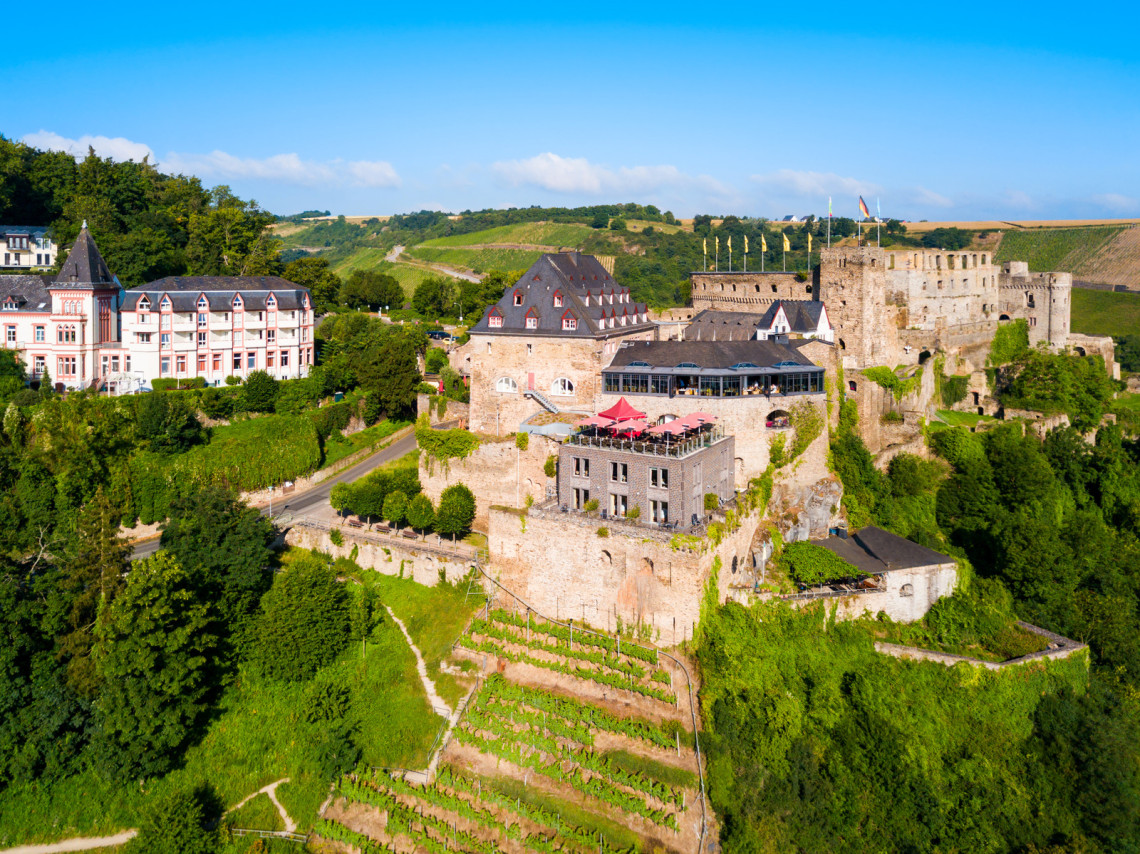
3. Burg Katz — the "cat" of the "cat and mouse"
Where: Above St. Goarshausen, east bank, opposite St. Goar.
Why it matters. Named "Katz" (cat) because a medieval rival built the nearby "Maus" (mouse) castle downstream, and locals joked about the cat catching the mouse. Rebuilt in the 19th century after French destruction. Now privately owned — visible from the Lorelei viewpoint but not open to visitors.
Best for: Photography only (not accessible for visits).
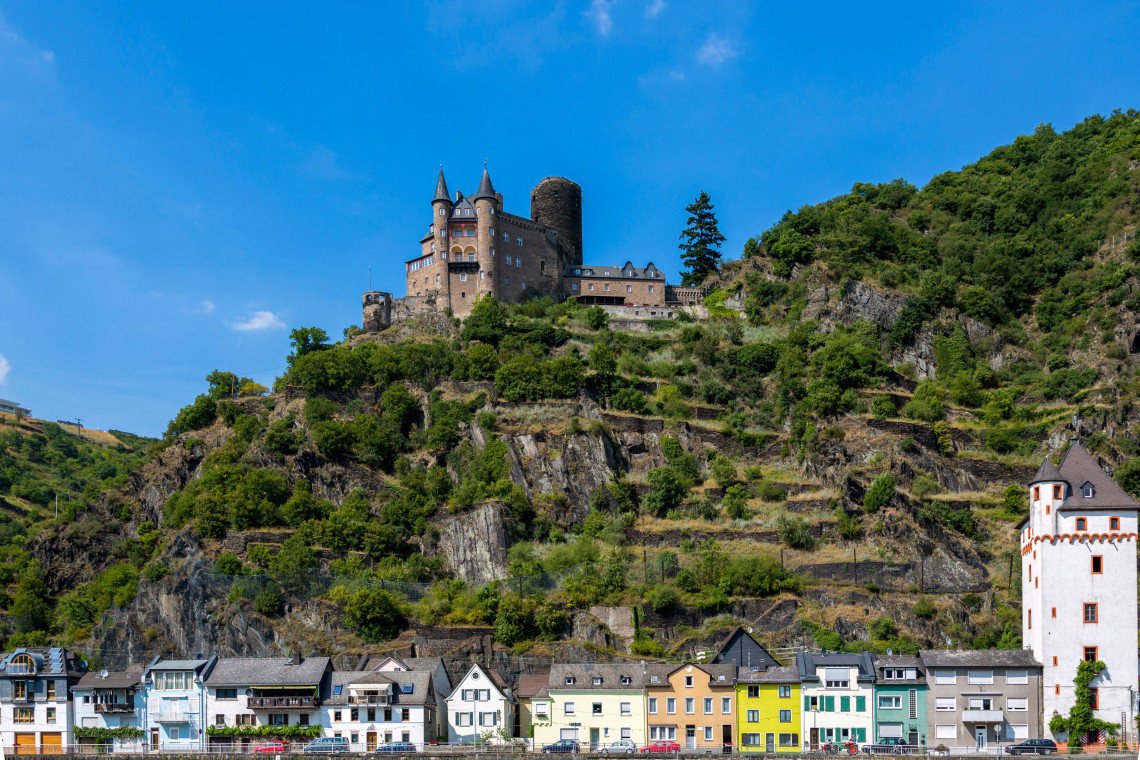
4. Burg Maus — the "mouse" (partly accessible)
Where: Wellmich, east bank, 3 km north of Katz.
Why it matters. The other half of the cat-and-mouse joke. Currently home to the Falconry School (Adlerwarte Katz), which does daily eagle and hawk demonstrations May to October — one of the more unusual castle experiences on the Rhine.
Best for: Families with children (raptor shows). Photographers.
Practical: Falconry demonstrations at 11am and 3pm daily May-October. €12.
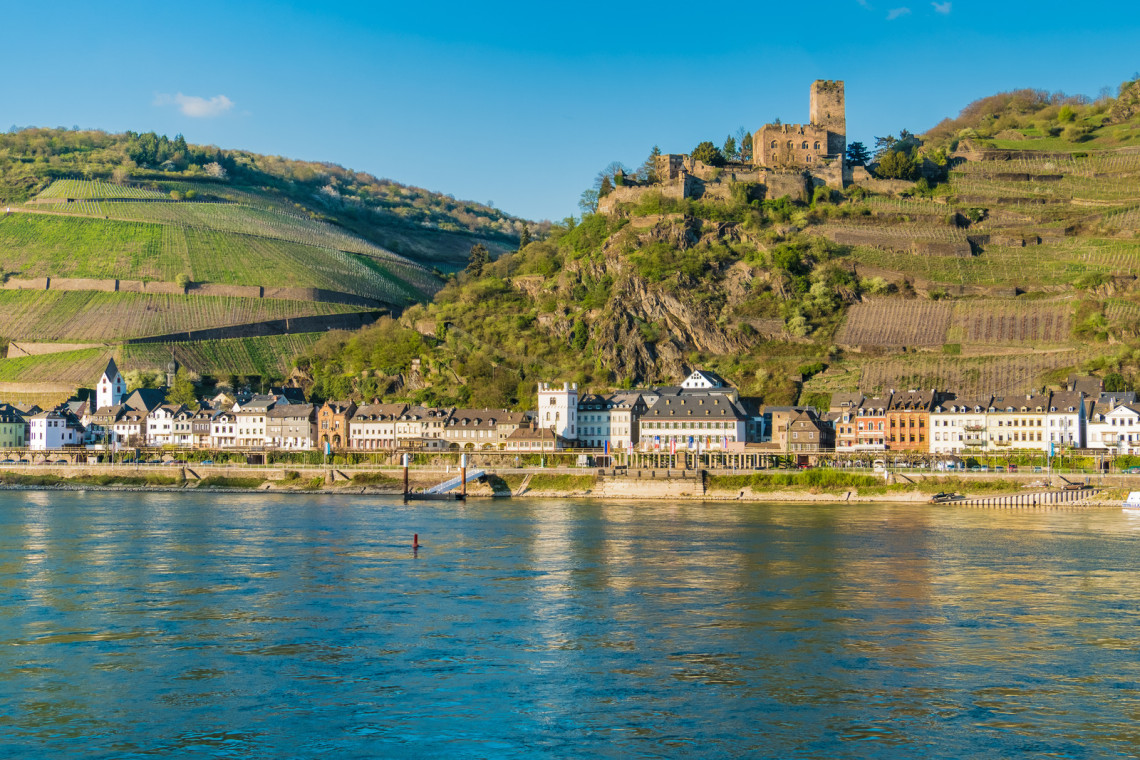
5. Pfalzgrafenstein — the castle on an island
Where: In the middle of the Rhine, near Kaub, opposite the mainland.
Why it matters. A 14th-century toll station built on a rock in the middle of the river. Ships could not pass without paying. Access by a small ferry from Kaub village (10 min crossing).
Best for: History travelers, unusual location seekers, photographers wanting the "boat on the Rhine with medieval castle" shot.
Practical: Ferry runs April to October. Castle open with tours. €10 admission including ferry.
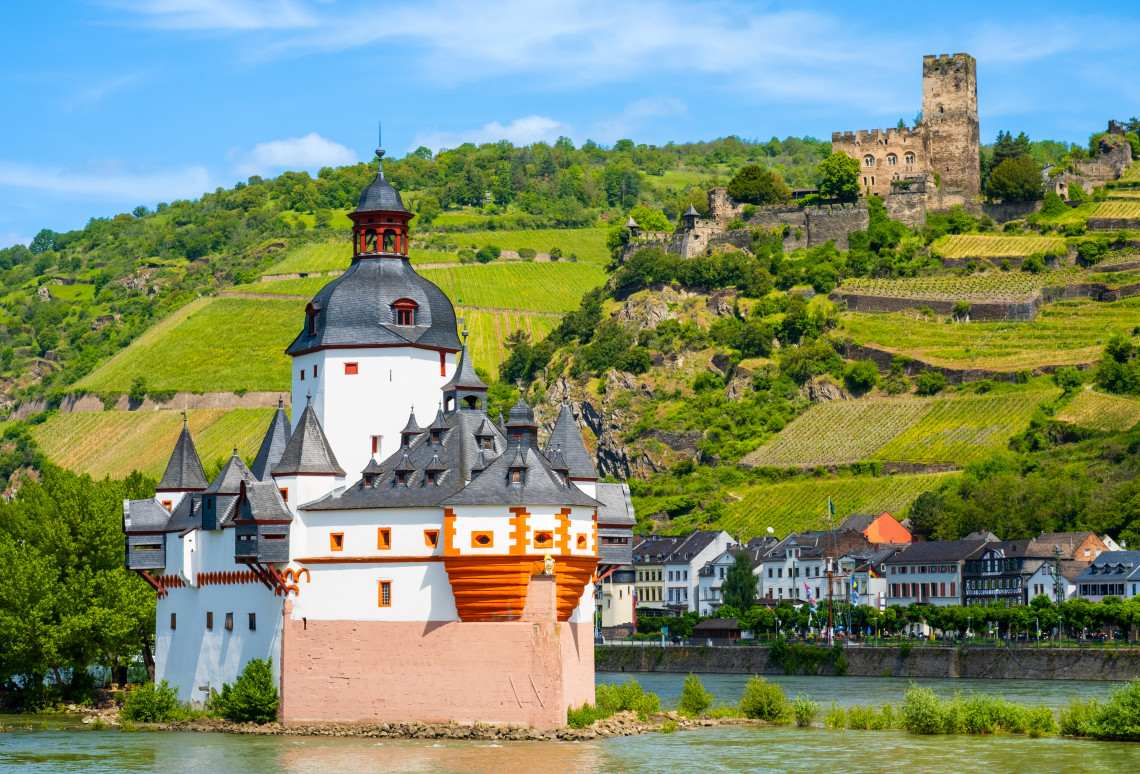
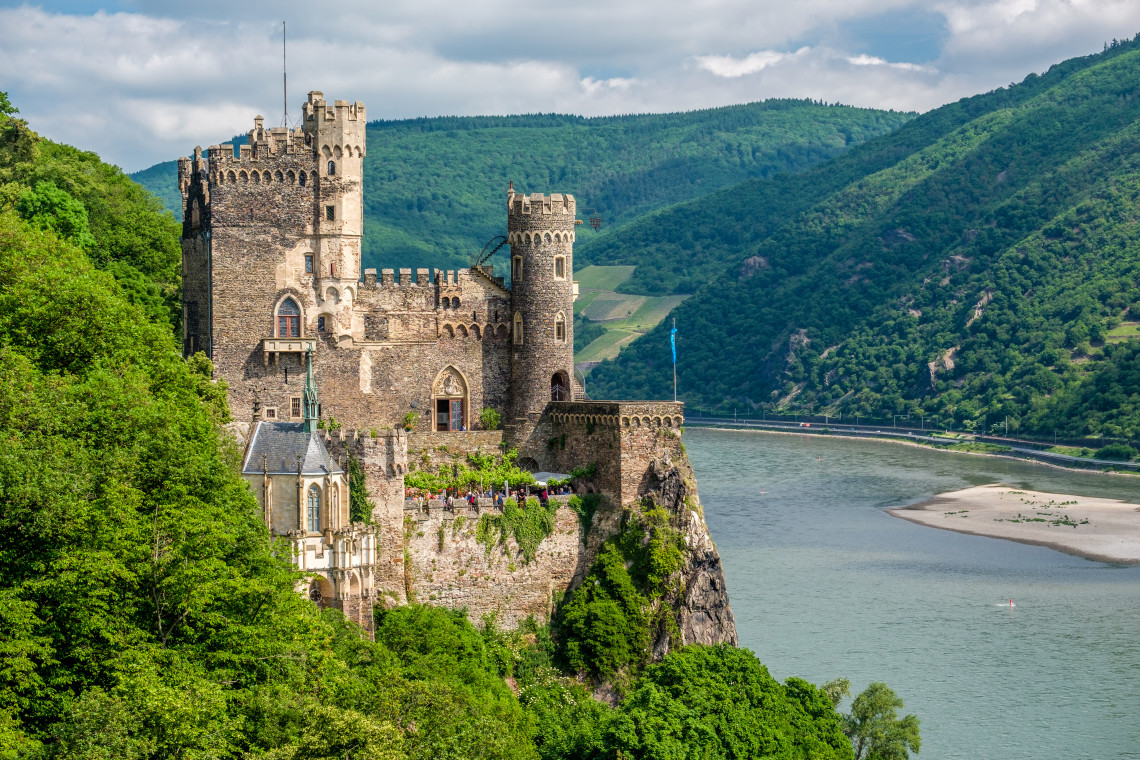
6. Burg Rheinstein — the 19th-century Romantic restoration
Where: Above Trechtingshausen, west bank, near Bingen.
Why it matters. The first castle to be restored in Romantic style (1825, by Prince Friedrich of Prussia). Fully furnished with 19th-century Gothic Revival decor. Very photogenic exterior with Neo-Gothic towers.
Best for: Romantic-era travelers, castle interior enthusiasts, easy access from Rüdesheim/Bingen.
Practical: Open March to November, 10am-5pm. €10 admission.
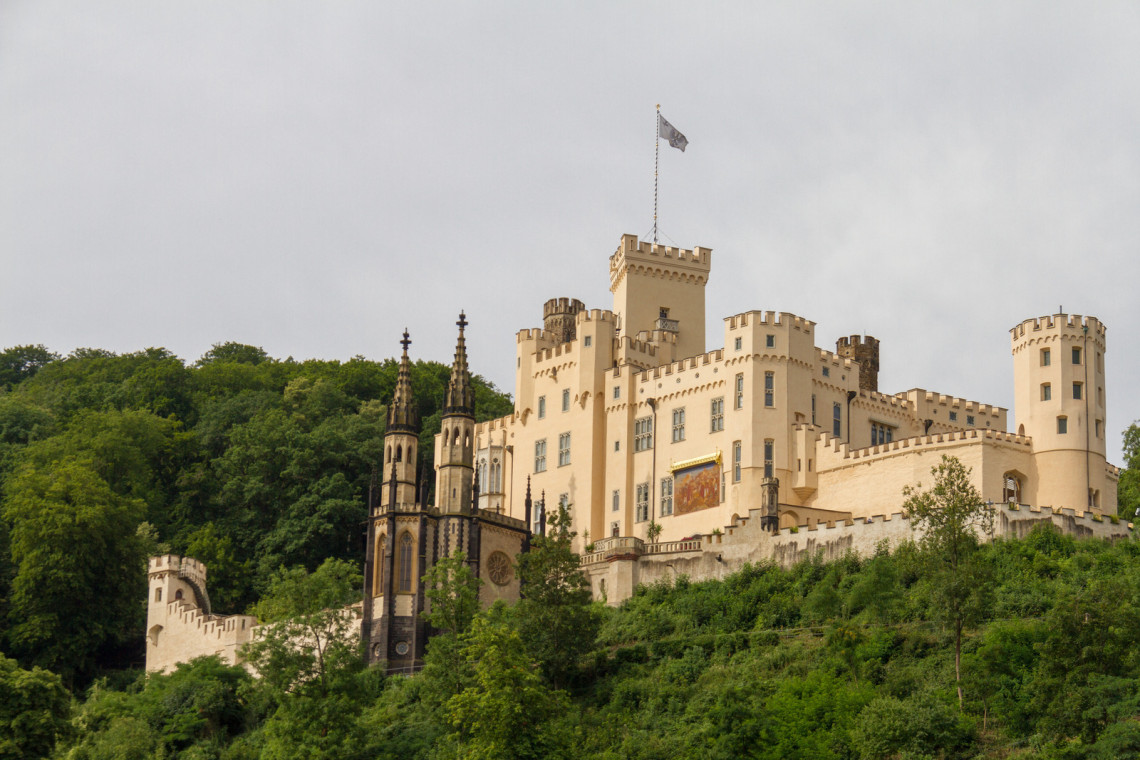
7. Schloss Stolzenfels — the Prussian king's palace
Where: Above Koblenz, west bank of the Rhine.
Why it matters. Rebuilt from ruins by King Friedrich Wilhelm IV of Prussia in the 1830s. More palace than castle. Elaborate Neo-Gothic interiors, exceptional Rhine views, formal gardens.
Best for: Palace interior enthusiasts, easy trip from Koblenz.
Practical: Open March-November, 10am-5pm. €7 admission.
8. The Lorelei
Where: Between St. Goar and St. Goarshausen, on the east bank.
Why it matters. Not a castle — a massive slate cliff (132m) rising over a narrow bend in the Rhine. Site of the German folk myth about the Lorelei mermaid who lured sailors to their deaths. The most famous rock in Germany, still commemorated in poems and songs.
Best for: Cultural/literary travelers, photographers, cruise ship stops.
Practical: Free to view from the road or river. Visitor center at the top has exhibits and viewpoint.
Rhine cruises: which to pick
The Rhine cruise industry between Koblenz and Rüdesheim is the classic way to see the castles.
KD Line (Köln-Düsseldorfer)
The historic Rhine cruise operator. Multiple daily boats between Koblenz, St. Goar, Bacharach, and Rüdesheim during April-October season.
- Koblenz to Rüdesheim one-way: 5h30m, €35-50.
- Rüdesheim to Koblenz one-way: 4h (downstream, faster).
- Half-day options: St. Goar to Rüdesheim, 2h.
- Combined ticket: Rüdesheim to Koblenz cruise + return train, €55-70.
Bingen-Rüdesheim ferry
Cross-river car ferry (10 min) between the two towns. Useful if driving both banks.
River cruise ships (multi-day)
Companies like Viking, AmaWaterways, Uniworld, and Avalon run 7-8 night Rhine cruises typically starting from Basel (Switzerland) or Amsterdam, stopping at Cologne, Koblenz, Rüdesheim, Strasbourg. These are separate from the KD Line day cruises.
The scenic train ride (free alternative)
The regional train from Koblenz to Bingen (west bank) or Koblenz to Rüdesheim (east bank) runs directly along the Rhine, passing 30+ castles. Included with any Deutsche Bahn regional ticket. Sit on the right side heading south for the best castle views. One of Europe's great free scenic train rides.
The wine villages
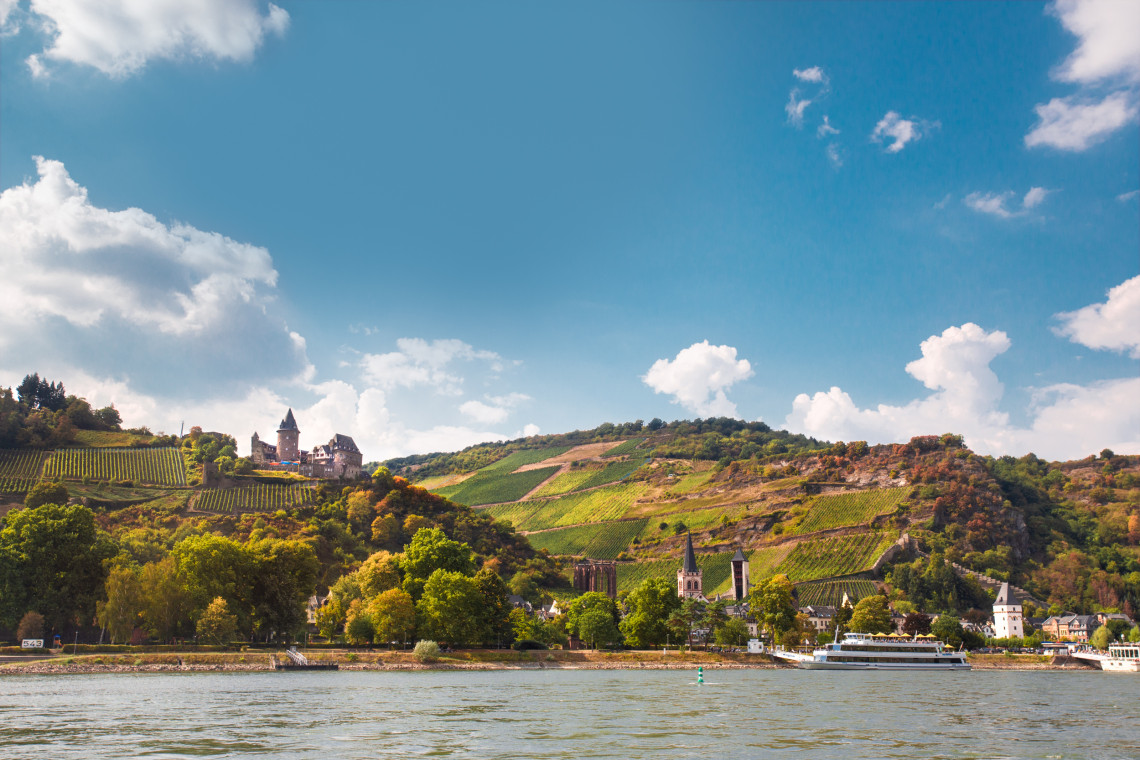
The Rhine castle stretch is also Riesling country. Steep vineyard slopes fall directly to the river.
Rüdesheim (west bank, southern end of the UNESCO zone). Wine town with the famous Drosselgasse cobblestone alley. Popular with cruise stops. Home to Asbach brandy. Cable car up to the Niederwald Monument (a 1883 statue commemorating the 1871 German Empire founding).
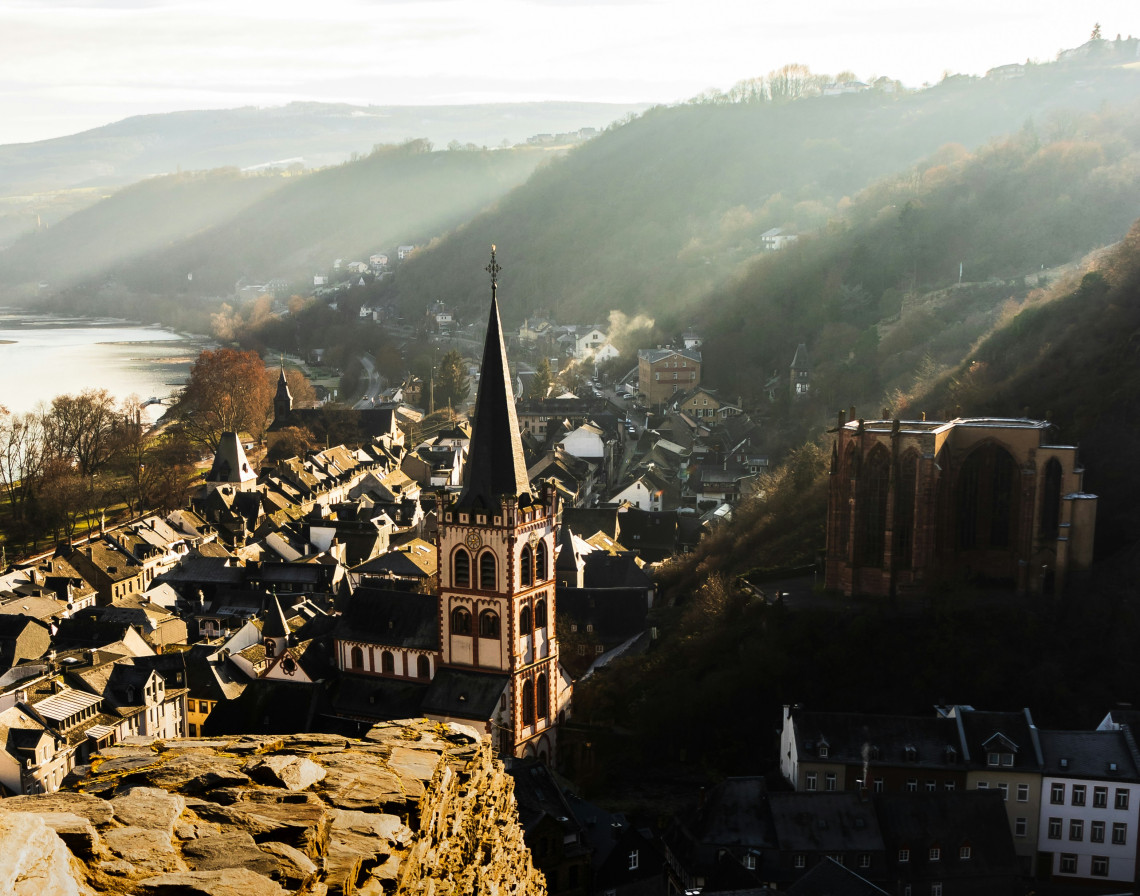
Bacharach (west bank, mid-valley). One of Germany's most beautiful medieval wine villages. Half-timbered houses, medieval walls, castle ruins above (Stahleck, now a youth hostel). Excellent Riesling from the surrounding slopes.
Assmannshausen (east bank, opposite Bacharach). Famous for Pinot Noir (Spätburgunder). Smaller village, less touristy than Rüdesheim.
Boppard (west bank, northern half). Larger wine and spa town. Marktplatz is atmospheric. Bopparder Hamm wine region.
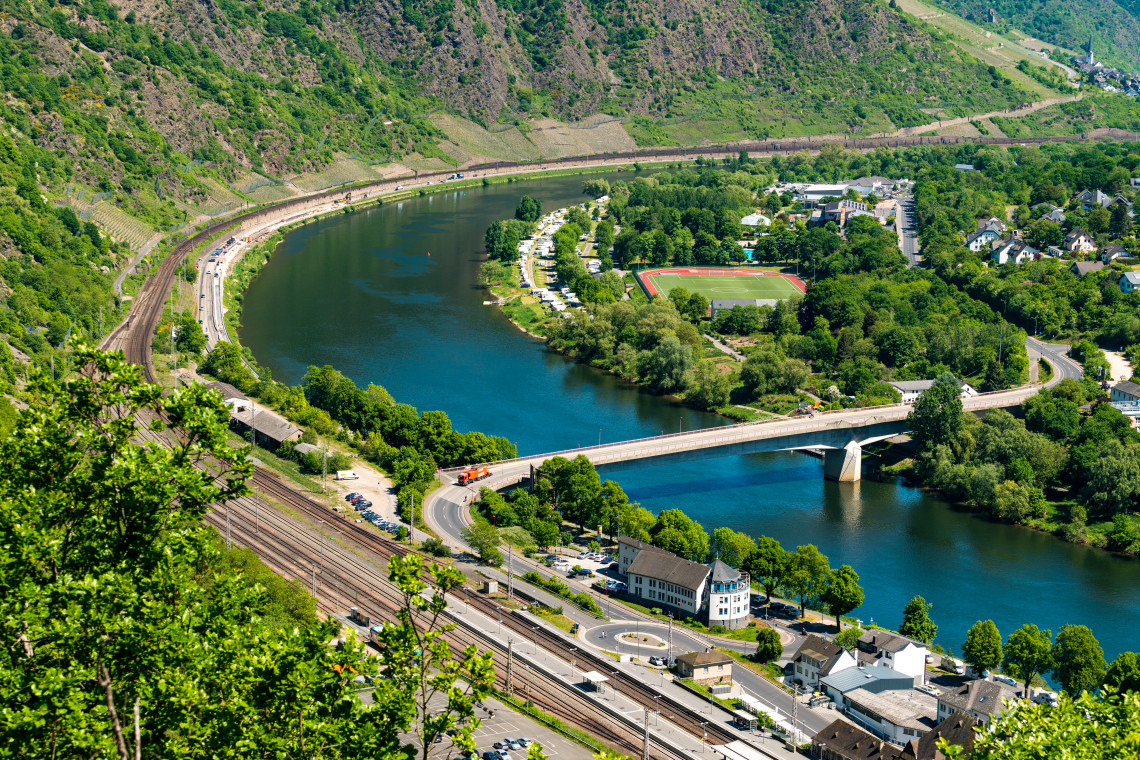
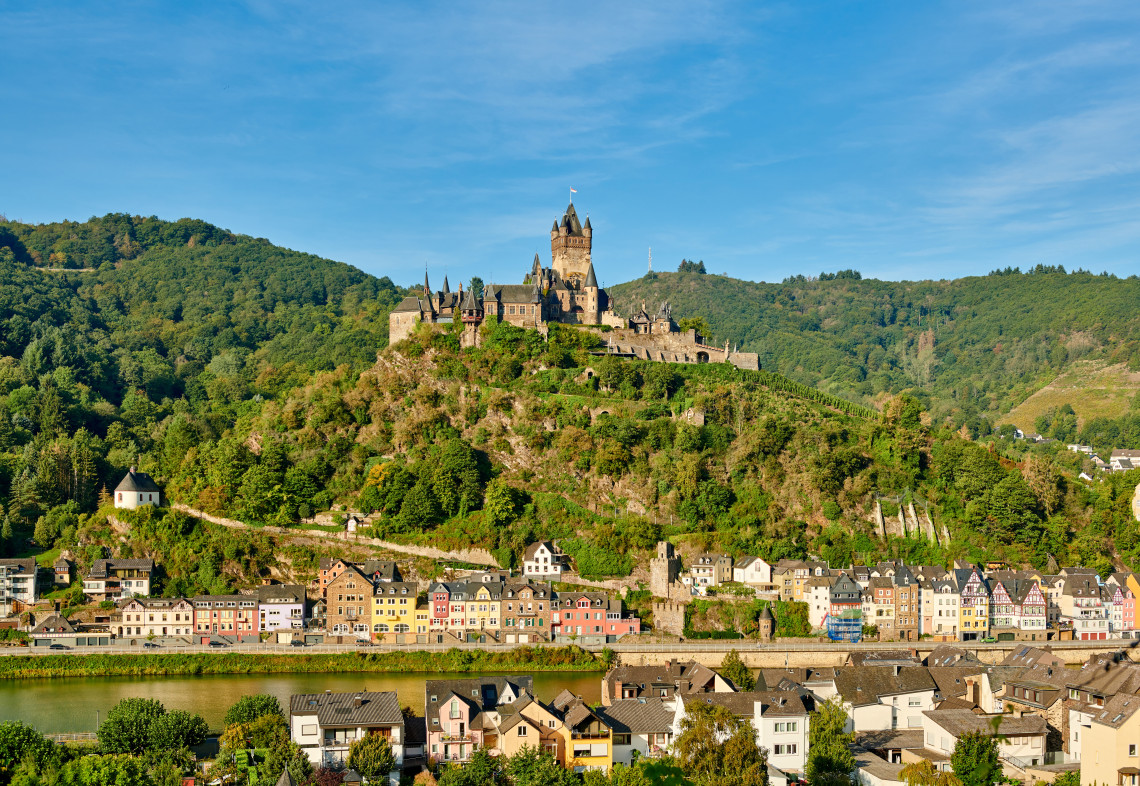
Cochem (on the Mosel River, tributary of the Rhine, 60 km northwest of Koblenz). Not technically on the Rhine but often included in Rhine trips. Beautiful medieval town with Reichsburg Cochem castle above. Excellent for combining Rhine and Mosel wine.
How to plan a Rhine trip
The classic 3-day Rhine trip
- Day 1: Arrive Frankfurt, drive to Rüdesheim (1h). Afternoon in Rüdesheim (Drosselgasse, wine tastings, Niederwald cable car).
- Day 2: Rhine cruise from Rüdesheim to Koblenz (4h downstream). Stop at St. Goar for lunch and Rheinfels castle. Continue to Koblenz. Return by evening train or overnight in Koblenz.
- Day 3: Explore Bacharach, Marksburg castle, or drive down Mosel to Cochem. Return to Frankfurt for departure.
The extended 5-day Rhine + Mosel trip
- Days 1-2: Rüdesheim base. Rhine cruise + castle visits.
- Days 3-4: Cochem (Mosel Valley). Reichsburg castle, wine tastings.
- Day 5: Cologne or Frankfurt for departure.
The Rhine + Bavarian classic (10 days)
- Days 1-3: Rhine (Rüdesheim base).
- Days 4-7: Munich + Neuschwanstein.
- Days 8-10: Berlin (via ICE from Munich, 4h).
Where to stay
Rüdesheim (southern end):
- Rüdesheimer Schloss — historic wine estate hotel in the center.
- Breuer's Rüdesheimer Schloss — 4-star traditional hotel.
Bacharach (mid-valley):
- Hotel Burg Stahleck — youth hostel inside a castle (basic but atmospheric).
- Weinhotel Peter Bach Bacharach — small family-run hotel.
Boppard (northern half):
- Hotel Bellevue Rheinhotel — riverside 4-star.
- Hotel Ebertor — mid-range in the old town.
Cochem (on Mosel):
- Reichsburg Hotel — inside the castle grounds.
- Villa Vinum Cochem — wine-themed boutique hotel.
Book 3-4 months ahead for peak season (May-July, September for harvest).
When to visit
Late April to mid October: Full boat cruise season. Best weather. Castles all open.
September: Wine harvest (Weinlese) with village festivals every weekend. Sturm (young wine) available in October.
December: Limited winter Rhine cruises (some KD Line boats operate for Christmas markets in Cologne). Not the classic experience but atmospheric for Christmas travelers.
November, January-March: Boat cruises largely suspended. Castles mostly closed. Villages quiet.
Honest tradeoffs
The pros: The most photogenic medieval castles concentration in Europe. Excellent Riesling. Easy logistics (well-connected by train). Reasonable prices. Combines with Cologne, Frankfurt, or Heidelberg. Family-friendly castles.
The cons: Peak season (July-August) cruises are crowded. Rain is more common than in Bavaria (river valley weather). Some Rhine towns feel overly cruise-ship-touristy (Rüdesheim especially). The Rhine outside the UNESCO zone (north of Koblenz, south of Bingen) is much less scenic.
To get the best version: Overnight in Bacharach or Boppard (quieter than Rüdesheim). Visit Marksburg early morning before cruise crowds. Combine at least one wine tasting per day. Take the scenic regional train once even if driving.
Frequently asked questions
Which is the best Rhine castle to visit? Marksburg is the only never-destroyed medieval castle on the Rhine — best for history authenticity. Rheinstein for Romantic-era restoration. Rheinfels for photogenic ruins. Choose 2-3 for a 3-day trip.
How many castles are on the Rhine? The UNESCO Middle Rhine Valley (Koblenz to Bingen, 65 km) has 32 castles. Broader Rhine (Cologne to Basel) has 40+ but concentration is in the Middle Rhine.
How long is a Rhine River cruise? Day cruise Koblenz to Rüdesheim: 5h30m upstream, 4h downstream. Multi-day river cruises (Viking, AmaWaterways): 7-8 nights typical, Basel to Amsterdam.
Is a Rhine cruise worth it? For most travelers, yes. The Rhine cruise between Koblenz and Rüdesheim is one of Europe's classic scenic boat rides. Comparable free experience: the regional train along the west bank.
When is the best time for a Rhine trip? Mid April to mid October for boats. September for wine harvest. Avoid November-March (boats suspended).
How do I get to the Rhine? Fly to Frankfurt (60 min south of Rüdesheim) or Cologne (30 min north of Koblenz). Rental car or regional train from both airports. Frankfurt is Germany's biggest U.S. hub.
Where should I base myself? Rüdesheim (touristy but connected), Bacharach (quiet medieval), Boppard (northern spa town), or Cochem (on Mosel). Rüdesheim is easiest for a first trip.
Can I combine the Rhine with the Mosel? Yes. Cochem is 60 km northwest of Koblenz on the Mosel River. Combined Rhine + Mosel trips are excellent — Mosel is quieter and more scenic in some ways than the Rhine.
How much do castle admissions cost? €7-10 each. Marksburg €10, Rheinfels €7, Rheinstein €10, Pfalzgrafenstein €10 (including ferry). Some castles are external-only (Katz, Maus).
Is the Lorelei worth visiting? Yes, briefly. The visitor center at the top of the rock has a small museum. The rock itself is photogenic from the river (best seen from a Rhine cruise) or from the viewpoint on top. 1-2 hour visit.
Can I stay overnight in a Rhine castle? Yes. Hotel Schloss Rheinfels (part of Rheinfels castle) offers castle stays. Burg Stahleck in Bacharach operates as a youth hostel. Reichsburg Cochem has a themed hotel.
Is the Rhine kid-friendly? Very. Castle tunnels at Rheinfels, falconry demonstrations at Burg Maus, boat rides, and the Lorelei mermaid story appeal to kids. Family-friendly hotels in Rüdesheim and Bacharach.
Your Rhine trip, hand-built.
Our Germany travel experts route the Rhine castle stretch, wine tastings, and combinations with Cologne, Frankfurt, or Mosel.
See Germany Packages Tailor-Made Trip